



 Posts
Posts


 (Wikipedia) The Skirmish of Sporting Hill was a relatively small skirmish during the Gettysburg Campaign of the American Civil War, taking place on June 30, 1863, at various locations in present day Camp Hill, East Pennsboro Township and Hampden Township in Cumberland County, Pennsylvania. It is known as the northernmost engagement of Robert E. Lee's Army of Northern Virginia during the Civil War. Continued
Jun 30, 2021
Skirmish of Sporting Hill


Jun 29, 2021
Mug Books
 "Late nineteenth- and early-twentieth-century mug books are collections of biographical sketches, a curiously rich source for geneologists and historians alike. Typically these books were published only by advance subscription. If a person had the funds to subscribe, he or she (more often he) would have a biographical sketch in the book. For an extra fee, a photograph or sketch would be included." Continued.
Jun 28, 2021
The burning of the Columbia–Wrightsville Bridge

 (Wikipedia) ... To prevent the advance of Confederate troops across the river from the Wrightsville (York County) side during the Civil War, the bridge was burned by Union militia under Maj. Granville O. Haller and Col. Jacob G. Frick on June 28, 1863. Civilian volunteers from Columbia had mined the bridge at the fourth span from the Wrightsville side, originally hoping to drop the whole 200-foot (61 m) span into the river, but when the charges were detonated, only small portions of the support arch splintered, leaving the span passable. As Confederates advanced onto the bridge, Union forces set fire to it near the Wrightsville side. Earlier they had saturated the structure with crude oil from a Columbia refinery.
The entire structure soon caught fire and completely burned in six hours. Confederate generals Jubal A. Early and John B. Gordon had originally planned to save the bridge despite orders from General Robert E. Lee to burn it, and Union forces under the command of Colonel Jacob G. Frick had burned the bridge, originally hoping to defend and save it. Afterwards, the Columbia Bank and Bridge Company appealed to the federal government for reimbursement for damages incurred from the bridge burning, but none were ever paid. Conservative estimates put the cost of damages with interest today at well over $170 million.
In 1864, the bank sold all interest in the bridge and bridge piers to the Pennsylvania Railroad for $57,000. The bank eventually went out of business, although the original building is now being renovated into a museum at Second and Locust Streets. Continued
(Wikipedia) ... To prevent the advance of Confederate troops across the river from the Wrightsville (York County) side during the Civil War, the bridge was burned by Union militia under Maj. Granville O. Haller and Col. Jacob G. Frick on June 28, 1863. Civilian volunteers from Columbia had mined the bridge at the fourth span from the Wrightsville side, originally hoping to drop the whole 200-foot (61 m) span into the river, but when the charges were detonated, only small portions of the support arch splintered, leaving the span passable. As Confederates advanced onto the bridge, Union forces set fire to it near the Wrightsville side. Earlier they had saturated the structure with crude oil from a Columbia refinery.
The entire structure soon caught fire and completely burned in six hours. Confederate generals Jubal A. Early and John B. Gordon had originally planned to save the bridge despite orders from General Robert E. Lee to burn it, and Union forces under the command of Colonel Jacob G. Frick had burned the bridge, originally hoping to defend and save it. Afterwards, the Columbia Bank and Bridge Company appealed to the federal government for reimbursement for damages incurred from the bridge burning, but none were ever paid. Conservative estimates put the cost of damages with interest today at well over $170 million.
In 1864, the bank sold all interest in the bridge and bridge piers to the Pennsylvania Railroad for $57,000. The bank eventually went out of business, although the original building is now being renovated into a museum at Second and Locust Streets. Continued
Jun 27, 2021
James Smithson

Photo: Theodor Horydczak
Jun 26, 2021
On the Boardwalk
 (LoC) On June 26, 1870, the first section of the Atlantic City Boardwalk opened along the New Jersey beach. ... Alexander Boardman, a railroad conductor, and Jacob Keim, a hotelier, conceived of the idea of constructing a boardwalk as a means of keeping sand out of the railroad cars and hotels. The city used its tax revenues to build an eight-foot-wide temporary wooden walkway from the beach into town that could be dismantled during the winter.
... Any consideration of the boardwalk demands at least a nod to salt water taffy, a favorite beachside treat. Taffy, a candy made of corn syrup and white sugar is boiled; the confection is pulled and folded, then rolled into a long strip from which shorter (about two-inch-long) strips are cut, wrapped in stick resistant paper, and sold. Along the Atlantic City Boardwalk folks have purchased the product since at least the early 1880s. In 1925, the Supreme Court ruled that the term "salt water taffy" could not be trademarked, a decision which saved candy manufacturers from paying millions of dollars to John R. Edmiston of Wildwood, New Jersey, who claimed to be the originator of the candy and had applied for registration of the term with the U.S. Patent Office. Continued
(LoC) On June 26, 1870, the first section of the Atlantic City Boardwalk opened along the New Jersey beach. ... Alexander Boardman, a railroad conductor, and Jacob Keim, a hotelier, conceived of the idea of constructing a boardwalk as a means of keeping sand out of the railroad cars and hotels. The city used its tax revenues to build an eight-foot-wide temporary wooden walkway from the beach into town that could be dismantled during the winter.
... Any consideration of the boardwalk demands at least a nod to salt water taffy, a favorite beachside treat. Taffy, a candy made of corn syrup and white sugar is boiled; the confection is pulled and folded, then rolled into a long strip from which shorter (about two-inch-long) strips are cut, wrapped in stick resistant paper, and sold. Along the Atlantic City Boardwalk folks have purchased the product since at least the early 1880s. In 1925, the Supreme Court ruled that the term "salt water taffy" could not be trademarked, a decision which saved candy manufacturers from paying millions of dollars to John R. Edmiston of Wildwood, New Jersey, who claimed to be the originator of the candy and had applied for registration of the term with the U.S. Patent Office. Continued
Jun 25, 2021
Country Churches: Old Chanceford

 We featured the newer church here, this is the old sanctuary, built in 1851. Quite a difference.
Canon EOS 5D, EF 28-135 mm f/3.5-5.6 IS lens
Jun 24, 2021
Margaret Brent
 (Wikipedia) Margaret Brent, (1601–1671), was the first woman in North American Colonies to act as an attorney before a court of the Common Law, and a significant founding participant in the early history of the Colony of Maryland and the Colony of Virginia. She ranks, with Anne Hutchinson among the most confrontational and controversial women figures to rise to prominence in early Colonial American history. Continued
Jun 23, 2021
Surrender at Fort Towson

 (Wikipedia) Fort Towson was a frontier outpost for Frontier Army Quartermasters along the Permanent Indian Frontier located about two miles (3 km) northeast of the present community of Fort Towson, Oklahoma. It was established in May 1824, under Col. Matthew Arbuckle, on the southern edge of Indian Territory to guard the Spanish border. It was named for Nathaniel Towson, Paymaster General of the Army. ... The last remaining Confederate Army troops, commanded by General Stand Watie, surrendered to Union forces at Fort Towson on June 23, 1865, following the Battle of Doaksville. Continued

Jun 22, 2021
Tom Dooley
 (Wikipedia) - Thomas C. Dula (June 22, 1845 – May 1, 1868) was a former Confederate soldier, who was tried, convicted, and hanged for the murder of his fiancée, Laura Foster. The trial and hanging received national publicity from newspapers such as The New York Times, thus turning Dula's story into a folk legend. While the murder happened in Wilkes County, North Carolina, the trial, conviction, and execution took place in Statesville, North Carolina. There was considerable controversy around his conviction and execution. In subsequent years, a folk song was written (entitled “Tom Dooley”, based on the pronunciation in the local dialect), and many oral traditions were passed down, regarding the sensational occurrences surrounding the murder of Foster, and Dula's subsequent execution. Continued
Jun 21, 2021
Country Churches: Chanceford Presbyterian

My favorite art museum is the outdoors. There's few things I enjoy more than driving through the countryside to discover some great work of art that I've never seen before - never even heard of. Which is why I don't resort to guidebooks when touring the area, I'd rather be surprised. And they are great works of art, many of them, the barns, chapels, and churches; even some of the the old factories & stores are mind bogglingly attractive. And they're just sitting there, out in a cornfield, or hidden between warehouses, waiting to be viewed by me, and hopefully, by you too.
 I don't know who designed the latest Chanceford Presbyterian Church building, but it looks similar to Centre Presbyterian, over in New Park, Pennsylvania, not very far away. Perhaps it was the same architect? They are both good looking buildings and I'm not sure which one I like more.
 The church was founded in 1751. Another building, perhaps an older sanctuary, also sits on the property. While I couldn't find a history of Chanceford Presbyterian, I did find reference to a sermon delivered there in 1865, on the topic of Lincoln's assassination. They were against it.
Photos: Canon EOS 5D ©falmanac
Jun 20, 2021
West Virginia Day

Jun 19, 2021
Along the Columbia & Port Deposit Railroad

Jun 18, 2021
Juneteenth
 (Wikipedia) - Over two years after the Emancipation Proclamation, slaves in Galveston, Texas, United States, are finally informed of their freedom. The anniversary is still officially celebrated in Texas and 13 other contiguous states as Juneteenth.
Photo: Slave pen, Alexandria, Virginia (Library of Congress).
Jun 17, 2021
Mencken and Waters
 "If H. L. Mencken was the Sage of Baltimore, Waters is, at least, the parsley. Just for fun, consider what these two share: impudence, contrariness, uproarious insults to bourgeois values that made them controversial, then fashionable, then had them prematurely posing for their native-son statues. That they’d have horrified each other is just your usual Balmer lagniappe." - Tom Carson

Photo of John Waters by Entheta, some rights reserved.
Jun 16, 2021
Mary Katherine Goddard
 (Maryland Women's Hall of Fame) - Mary Katherine Goddard, printer, newspaper publisher, and postmaster, was born in Connecticut on June 16, 1738. She lived in Baltimore, Maryland from 1774 until her death at age seventy-eight, in 1816. ... Mary Katherine proved to be a steady, impersonal newspaper editor and during the Revolution she was usually Baltimore’s only printer. From her press, in January 1777, came the first printed copy of the Declaration of Independence to include the names of the signers. Mary Katherine Goddard was also responsible for issuing several Almanacs, while in Baltimore, which now hold a place in the Maryland Historical Society.
... In 1775, Mary Katherine became postmaster of Baltimore, probably the first woman so appointed in the colonies, and certainly the only one to hold so important a post after the Declaration of Independence. Continued
(Maryland Women's Hall of Fame) - Mary Katherine Goddard, printer, newspaper publisher, and postmaster, was born in Connecticut on June 16, 1738. She lived in Baltimore, Maryland from 1774 until her death at age seventy-eight, in 1816. ... Mary Katherine proved to be a steady, impersonal newspaper editor and during the Revolution she was usually Baltimore’s only printer. From her press, in January 1777, came the first printed copy of the Declaration of Independence to include the names of the signers. Mary Katherine Goddard was also responsible for issuing several Almanacs, while in Baltimore, which now hold a place in the Maryland Historical Society.
... In 1775, Mary Katherine became postmaster of Baltimore, probably the first woman so appointed in the colonies, and certainly the only one to hold so important a post after the Declaration of Independence. Continued
Country Churches: Holy Cross Episcopal
 A picturesque pile protruding from an asphalt pond. Harford County, Maryland ca 1887.
Jun 15, 2021
Josiah Henson
 (Wikipedia) Josiah Henson (June 15, 1789 – May 5, 1883) was born into slavery in Charles County, Maryland. He escaped to Ontario, Canada in 1830, and founded a settlement and laborer's school for other fugitive slaves at Dawn, near Dresden in Kent County.
... The cabin in which Josiah Henson and other slaves were housed remains standing and is currently nestled amidst a residential development in Montgomery County, Maryland. ... After having remained in the hands of private owners for nearly two centuries, on January 6, 2006, the Montgomery Planning Board agreed to purchase the property and the acre of land on which it stands for $1,000,000. The house was opened to the public for one weekend in 2006. The Board plans to open the cabin to the public on a regular basis when possible. Continued
(Wikipedia) Josiah Henson (June 15, 1789 – May 5, 1883) was born into slavery in Charles County, Maryland. He escaped to Ontario, Canada in 1830, and founded a settlement and laborer's school for other fugitive slaves at Dawn, near Dresden in Kent County.
... The cabin in which Josiah Henson and other slaves were housed remains standing and is currently nestled amidst a residential development in Montgomery County, Maryland. ... After having remained in the hands of private owners for nearly two centuries, on January 6, 2006, the Montgomery Planning Board agreed to purchase the property and the acre of land on which it stands for $1,000,000. The house was opened to the public for one weekend in 2006. The Board plans to open the cabin to the public on a regular basis when possible. Continued

Photo: Henry Hartley, Wikipedia
Jun 14, 2021
Flag Day

(LoC) - On June 14, 1777, the Continental
Congress approved the design of a national flag. Since 1916, when President
Woodrow Wilson issued a presidential proclamation establishing a national Flag
Day on June 14, Americans have commemorated the adoption of the Stars and
Stripes by celebrating June 14 as Flag Day. Prior to 1916, many localities and a
few states had been celebrating the day for years. Continued
Jun 13, 2021
Office of War Information
 (LoC) On June 13, 1942, some six months after the bombing of Pearl Harbor, the Office of War Information (OWI) was created. In October of that year, the documentary photography unit of the Farm Security Administration (FSA) was transferred to the OWI to document the war effort, as it had the U.S government’s battle against poverty during the Great Depression. An important U.S. government propaganda agency during World War II, the OWI supported America’s mobilization for the war effort by recording the nation's preparations for war in films, texts, photographs, radio programs, and posters. OWI photographers documented American life and culture during the early years of World War II, focusing on such subjects as aircraft factories, training for war work, women in the workforce, and the armed forces. Photographs were created to inspire patriotism in the American public. Continued

Jun 12, 2021
June 12, 1897: The Swiss Army Gets Its Own Knife
 (Wired) - 1897: Karl Elsener legally registers his "soldiers' knife" for use by the Swiss army.
In an age when nationalism was fashionable, Elsener, a Swiss manufacturer of surgical instruments and cutlery, was a very fashionable man indeed. So he was less than thrilled to learn that the Swiss army was importing Solingen blades from neighboring Germany. Elsener set out to develop a homegrown multifunctional tool worthy of being carried by his local Alpine troops. Continued
(Wired) - 1897: Karl Elsener legally registers his "soldiers' knife" for use by the Swiss army.
In an age when nationalism was fashionable, Elsener, a Swiss manufacturer of surgical instruments and cutlery, was a very fashionable man indeed. So he was less than thrilled to learn that the Swiss army was importing Solingen blades from neighboring Germany. Elsener set out to develop a homegrown multifunctional tool worthy of being carried by his local Alpine troops. Continued
Photo: Courtesy Victorinox/Wired
Jun 11, 2021
Lindbergh Honored
 (LoC) On June 11, 1927, Charles Lindbergh received the first Distinguished Flying Cross ever awarded. Since 1927, aviators honored with this medal have included World War II pilots President George Bush, Senator George McGovern, and astronaut Virgil "Gus" Grissom who flew one hundred missions during the Korean War.
Lindbergh's nonstop solo flight across the Atlantic on May 20-21, 1927, made aeronautical history. The stunt-flyer-turned-airmail-pilot's flight was underwritten by a group of St. Louis businessmen. Flying his monoplane, Spirit of St. Louis, Lindbergh captured the $25,000 prize offered for the first flight between New York and Paris. Continued
(LoC) On June 11, 1927, Charles Lindbergh received the first Distinguished Flying Cross ever awarded. Since 1927, aviators honored with this medal have included World War II pilots President George Bush, Senator George McGovern, and astronaut Virgil "Gus" Grissom who flew one hundred missions during the Korean War.
Lindbergh's nonstop solo flight across the Atlantic on May 20-21, 1927, made aeronautical history. The stunt-flyer-turned-airmail-pilot's flight was underwritten by a group of St. Louis businessmen. Flying his monoplane, Spirit of St. Louis, Lindbergh captured the $25,000 prize offered for the first flight between New York and Paris. Continued
Photo: Charles Lindbergh on podium on Washington Monument grounds during his Wash., D.C. reception; Army band in foreground: Lindbergh speaking (LoC)
Jun 10, 2021
Ken Singleton
 (Wikipedia) - Kenneth Wayne Singleton (born June 10, 1947) is a retired American Major League Baseball outfielder/designated hitter and current television announcer. ... During his ten years in Baltimore, Singleton played the best baseball of his career as the Orioles won two pennants, in 1979 and 1983, and won the 1983 World Series. His batting average of .328 in 1977, good for third in the league, was a career high, and he posted 35 homers and 111 RBIs in 1979, also the best totals of his career in those departments. He retired after the 1984 season. Continued
Photo: Wikipedia
Jun 9, 2021


Jun 8, 2021
Root Boy Slim
 (Wikipedia) Root Boy Slim (born Foster MacKenzie III on July 9, 1945 in Asheville, North Carolina - died June 8 1993) was an American singer-songwriter who attended Yale University, and afterward settled in the suburbs of Washington, D.C., gaining fame as the frontman for the band "Root Boy Slim and the Sex Change Band".
He died in his sleep in his home in Orlando, Florida at the age of 47, and is buried in Fletcher, North Carolina. He was inducted into the Washington Area Music Association Hall of Fame in 2004. Continued
(Wikipedia) Root Boy Slim (born Foster MacKenzie III on July 9, 1945 in Asheville, North Carolina - died June 8 1993) was an American singer-songwriter who attended Yale University, and afterward settled in the suburbs of Washington, D.C., gaining fame as the frontman for the band "Root Boy Slim and the Sex Change Band".
He died in his sleep in his home in Orlando, Florida at the age of 47, and is buried in Fletcher, North Carolina. He was inducted into the Washington Area Music Association Hall of Fame in 2004. Continued
Jun 7, 2021


Jun 6, 2021
29th Infantry Division at D-Day
 |
| Clearing the Vierville Draw by Larry Selman |
(D-Day Overlord) The 29th American Infantry Division was founded on 3 February 1941 and brought together men belonging to the National Guard. Comprised of four battalions and based in Fort Meade (Maryland, USA), it receives from its creation a large number of vehicles and equipment freshly out of the weapons factories. Continued
Jun 5, 2021
Alfred Hilton
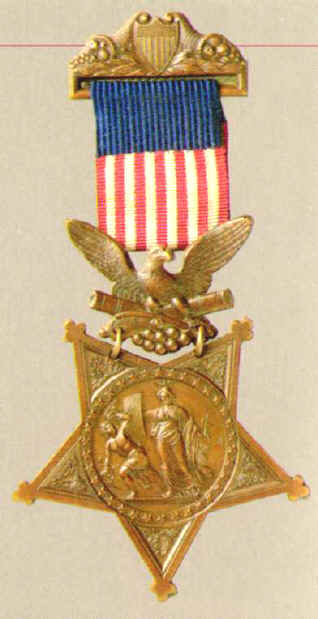 Hilton, Alfred B.
ACTION: Chaffin's Farm (Fort Harrison), VA.
DATE: 29 September 1864.
NAME: Hilton, Alfred B.
RANK/UNIT: Sergeant, Co. H, 4th U.S. Colored Troops.
CITATION: "When the regimental color bearer fell, this soldier seized the color and carried it forward, together with the national standard, until disabled at the enemy's inner line."
MEDAL PRESENTED: 6 April 1865 (Posthumous).
BIOGRAPHICAL DATA: Born: Havre de Grace, Harford County, MD. 1842.
ENTERED SERVICE: Baltimore, MD. 11 August 1863.
PHOTOGRAPH/SKETCH: N/A
OTHER: Alfred Hilton was a 21-year-old farmer when he enlisted in the U.S. Army. He stood 5'10 and 1/2" tall. Sergeant Hilton was severely wounded in the fierce fighting of September 29th, and his right leg had to be amputated below the knee. He died in the hospital at Fort Monroe on October 21st. He is buried at Hampton, VA.
SOURCES: Medal, p. 117; Bearss.
An order from Gen. Benjamin Butler, dated 11 October 1864, had this to say:
Alfred B. Hilton, color-sergeant, Fourth U.S. Colored Troops, the bearer of the national colors, when the color-sergeant with the regimental standard fell beside him, seized the standard, and struggled forward with both colors, until disabled by a severe wound at the enemy's inner line of abatis, and when on the ground he showed that his thoughts were for the colors and not for himself. He has a special medal for gallantry, and will have his warrant as first sergeant. Official Records, #89, p169
Hilton, Alfred B.
ACTION: Chaffin's Farm (Fort Harrison), VA.
DATE: 29 September 1864.
NAME: Hilton, Alfred B.
RANK/UNIT: Sergeant, Co. H, 4th U.S. Colored Troops.
CITATION: "When the regimental color bearer fell, this soldier seized the color and carried it forward, together with the national standard, until disabled at the enemy's inner line."
MEDAL PRESENTED: 6 April 1865 (Posthumous).
BIOGRAPHICAL DATA: Born: Havre de Grace, Harford County, MD. 1842.
ENTERED SERVICE: Baltimore, MD. 11 August 1863.
PHOTOGRAPH/SKETCH: N/A
OTHER: Alfred Hilton was a 21-year-old farmer when he enlisted in the U.S. Army. He stood 5'10 and 1/2" tall. Sergeant Hilton was severely wounded in the fierce fighting of September 29th, and his right leg had to be amputated below the knee. He died in the hospital at Fort Monroe on October 21st. He is buried at Hampton, VA.
SOURCES: Medal, p. 117; Bearss.
An order from Gen. Benjamin Butler, dated 11 October 1864, had this to say:
Alfred B. Hilton, color-sergeant, Fourth U.S. Colored Troops, the bearer of the national colors, when the color-sergeant with the regimental standard fell beside him, seized the standard, and struggled forward with both colors, until disabled by a severe wound at the enemy's inner line of abatis, and when on the ground he showed that his thoughts were for the colors and not for himself. He has a special medal for gallantry, and will have his warrant as first sergeant. Official Records, #89, p169
Jun 4, 2021
Concord Point Lighthouse


"Concord Point Lighthouse at Havre de Grace, Maryland was established to warn seafaring vessels away from the treacherous currents and shoals near the mouth of the Susquehanna River. Master builder John Donahoo was responsible for the construction of the lighthouse in his hometown, where he also served multiple terms as a Havre de Grace town commissioner. At the time of its decommissioning in 1975, the Concord Point Lighthouse had the distinction of being the oldest beacon in continuous use in the entire state of Maryland. The name Concord Point is derived from Conquered Point, which is itself a rearrangement of the original christening, Point of Conquest." Continued.
Jun 3, 2021
Food Bloggers of 1940
 (NYTBR) - ... Writers fanned out across the republic to document — via field reports, essays, stories, poems, recipes and interviews — what academics have taken to calling “foodways.” Among the topics covered were New York soda-luncheonette slang, Georgia possum cookery, Minnesota lutefisk, geoduck clams in Washington State, Montana’s fried beaver tail, Colorado food superstitions (“You will receive mail from the direction in which your pie is pointing, when it is set down at your place at the table”), a Choctaw “funeral cry” feast and “a Los Angeles sandwich called a taco.” Throughout 1940 and 1941, raw copy flowed into Washington, D.C., where it was farmed out to rewriters — including Nelson Algren — for shaping into book form. Then came Pearl Harbor. The Federal Writers’ Project — “one of the noblest and most absurd undertakings ever attempted by any state,” as W. H. Auden described it — morphed into the Writers Unit of the War Services, and “America Eats” went down as a war casualty. Continued
Photo: "Serving up the barbeque at the Pie Town, New Mexico, Fair," Octorber 1940, Russel Lee (FSA/OWI/LOC).
Jun 2, 2021
Indian Citizenship Act
 (LoC) On June 2, 1924, Congress enacted the Indian Citizenship Act, which granted citizenship to all Native Americans born in the U.S. The right to vote, however, was governed by state law; until 1957, some states barred Native Americans from voting. Continued
Subscribe to:
Comments (Atom)